Data Integration: The Solution to Overcome Double Entry Syndrome in Companies
Double entry syndrome in companies is a condition where the same data must be entered repeatedly into multiple systems due to the lack of data integration across departments. The solution is to implement an integrated ERP system that allows a single data input for all operations, ensuring greater accuracy, synchronization, and efficiency.
In practice, many businesses do not realize that this repeated data entry process is actually a major bottleneck. Teams may appear busy and reports continue to run, but behind the scenes, time is wasted, errors increase, and decisions are delayed because the data is never truly aligned.
What Is Double Entry Syndrome in Business Operations
Double entry syndrome occurs when the same data must be entered into multiple systems due to the absence of an integrated business system. This condition is often considered normal, even though it is a major source of operational inefficiency.
1. When One Data Point Must Be Entered into Multiple Systems
This situation typically happens when the sales team records transactions in spreadsheets, the finance team re-enters the data into accounting software, and the operations team inputs it again into an inventory system. As a result, a single data point exists separately across different departments.
2. Why Double Entry Often Goes Unnoticed by Management
Because it has become a routine, many companies consider this process part of normal workflows. However, without realizing it, this duplicate data entry problem continuously reduces efficiency.
3. The Difference Between Double Entry Syndrome and Integrated Systems
In manual systems, data must be entered repeatedly across multiple platforms. In contrast, an integrated ERP system allows data to be entered once and automatically shared across all relevant departments.
Causes of Double Entry Syndrome in Many Companies
Double entry syndrome does not occur randomly but is usually the result of operational habits and a lack of system planning.
1. Each Department Uses Different Tools
Sales, finance, HR, and operations often use separate software without data integration. As a result, data does not flow automatically and must be re-entered multiple times.
2. Reliance on Spreadsheets for Core Operations
While spreadsheets are flexible, they are not designed for integrated systems across sales, finance, and inventory. When used as the main data source, the risk of duplication and inconsistency increases.
3. Lack of a Structured System Architecture
Many companies adopt new tools gradually without a long-term integration strategy. This results in fragmented systems that are difficult to synchronize.
The Impact of Double Entry on Business Efficiency and Accuracy
This issue is not just about time—it directly affects the quality of business decisions.
1. Higher Risk of Human Error
The more often data is re-entered, the higher the chance of mistakes. Small errors in numbers or inputs can significantly impact financial or operational reports.
2. Data Becomes Unsynchronized Across Departments
Since each department maintains its own version of the data, inconsistencies frequently occur. This makes coordination more difficult and increases the risk of data conflicts.
3. Slower Business Decision-Making
Management must wait for data consolidation from multiple sources before making decisions. This delays response time and causes businesses to miss opportunities.
Comparison: Double Entry System vs Integrated ERP System
To make it easier to understand, here’s a simple comparison between a double entry system and an integrated ERP system in business operations:
| Operational Aspect | Double Entry System | Integrated ERP System |
| Data Input | Data must be entered multiple times | Data entered once |
| Data Synchronization | Often inconsistent across departments | Automatically synchronized |
| Error Risk | High due to manual input | Lower |
| Reporting Speed | Slow due to consolidation | Real-time |
| Team Efficiency | Time spent on data reprocessing | Focus on analysis and strategy |
The table shows that ERP solutions for operational efficiency are not just about technology, but also about improving the way businesses work.
Why Data Integration Is the Key Solution
Data integration across departments eliminates repetitive processes and improves business transparency.
1. The “Single Source of Truth” Principle
In an integrated system, all data is stored in one central source. This ensures that all teams work with the same accurate and consistent information.
2. Single Data Entry for All Departments
With an integrated system, data only needs to be entered once and becomes instantly available to all relevant teams. This removes the need for duplicate input.
3. Real-Time Data Updates Across Operations
Any data changes are immediately visible across departments, enabling faster coordination and better responsiveness.

The Role of ERP in Connecting Cross-Department Data
ERP serves as the foundation for building integrated systems in modern companies.
1. Integration of Sales, Finance, and Inventory Data
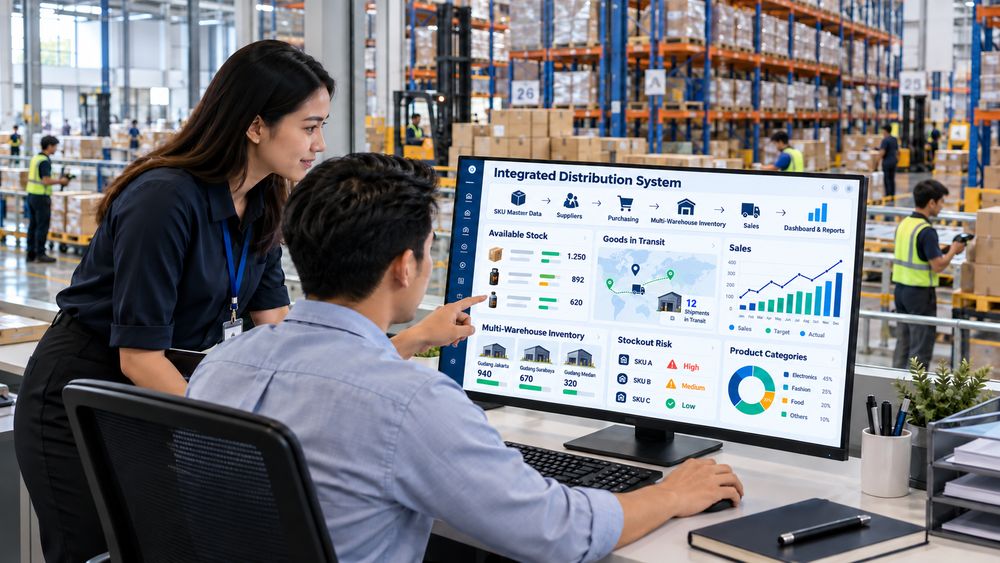
ERP enables seamless integration of sales, finance, and inventory within a single platform. All business activities are recorded in one connected system.
2. Automation of Previously Manual Processes
Processes such as transaction recording, stock updates, and report generation can run automatically. This reduces manual workload and increases accuracy.
3. Data Transparency for Management and Operations
With integrated dashboards, management can monitor business performance in real time, enabling faster and more data-driven decisions.
Summary: Why System Integration Matters for Business Efficiency
Double entry syndrome occurs when data must be repeatedly entered into multiple systems due to a lack of integration. The main causes include disconnected tools, reliance on spreadsheets, and the absence of structured system architecture.
Its impact goes beyond efficiency—it affects data accuracy and decision-making speed. Unsynchronized data and high human error risks make business operations less optimal.
By implementing an integrated ERP system, companies can eliminate duplicate data entry, ensure real-time data access, and create a connected business ecosystem. As a result, businesses not only operate faster but also make more accurate decisions and are better prepared for sustainable growth.
ERP integration becomes a strategic step toward building faster, more accurate, and scalable operations.
FAQ – Double Entry Syndrome and Data Integration
Here are some frequently asked questions related to double entry syndrome and data integration solutions.
1. What is Double Entry Syndrome in business?
Double Entry Syndrome is a condition where the same data must be entered repeatedly into multiple systems because business applications are not integrated.
2. Why does Double Entry Syndrome occur in companies?
It occurs because each department uses different tools such as spreadsheets, accounting software, and inventory systems that are not connected.
3. What is the impact of Double Entry on business operations?
It increases the risk of human error, causes data inconsistencies across departments, and slows down reporting processes.
4. How can Double Entry Syndrome be solved?
The most effective solution is implementing an integrated ERP system that connects data across departments automatically.
5. Is ERP suitable for mid-sized companies?
Yes. Modern ERP systems are flexible and can be used by SMEs to large enterprises to improve operational efficiency.
In the end, double entry syndrome shows that a business needs a better system to support its operations. By using integrated systems, companies can work more efficiently, reduce errors, and manage their data more effectively as they grow.
It’s Time to Eliminate Repetitive Processes That Slow Down Business Growth
If your company is still facing duplicate data entry issues and unsynchronized data across departments, it is a sign that your system needs integration. Smart IT helps you build an integrated ERP system that connects all departments into one platform, enabling more efficient, accurate, and scalable operations. Contact our team today for a consultation.
PT SMARTIT MANTAP DIGITAL INDONESIA
Vieloft Ciputra World, Suite 10-01.
Kompleks Superblock, Ciputra World
Jl. Mayjen Sungkono No.89 Surabaya, Jawa Timur, Indonesia 60224
Telepon: +6281130576888 / +628113426391
Email: hello@smart-it.co.id
Facebook: Smart IT Indonesia
LinkedIn: Smart IT Indonesia
Instagram: smartitcoid