Traditional Firewall vs Modern Firewall: Which Is More Suitable for Your Company?
| Aspect | Traditional Firewall | Modern Firewall/NGFW |
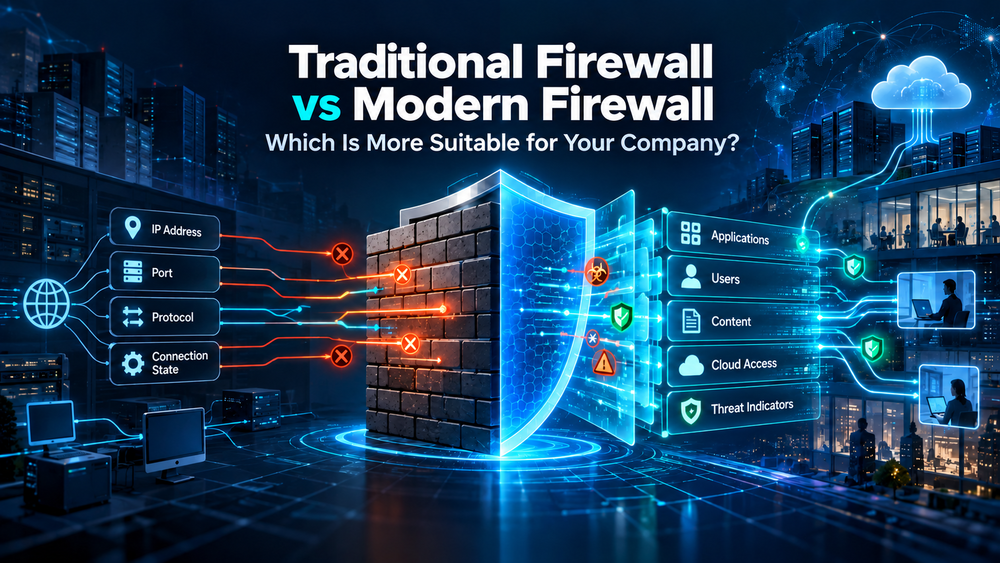
| Control basis | IP addresses, ports, protocols, and connection states | Adds applications, users, content, reputation, and context |
| Traffic inspection | Focuses on packet headers and connection sessions | Can perform deeper inspection |
| Application control | Limited or dependent on port numbers | Can identify and control applications |
| Threat detection | Requires additional security controls | Can include IPS and threat prevention |
| Visibility | Basic network logs | Visibility into applications, users, threats, and activities |
| Management | Network rules | More centralized and granular security policies |
| Typical use | Simple networks requiring basic controls | Complex networks involving cloud services, remote access, and multiple applications |
Traditional firewalls remain suitable for simple networks that rely on controls based on IP addresses, ports, protocols, and connection states. Meanwhile, modern firewalls for enterprise network security are more appropriate when businesses need application and user control, threat detection, and greater visibility.
As cloud applications, devices, branches, and remote access expand, an operational firewall may no longer be adequate. Companies should therefore assess whether their current system only requires optimization or needs to be modernized.
Note: Firewall configuration can affect both security and business connectivity. Changes to firewall rules, encrypted traffic inspection, and device migration should be preceded by network mapping, testing, and a recovery plan prepared by personnel who understand the company’s network architecture.
1. Compare How They Inspect Traffic
The main difference lies in the depth of inspection and the context used to make security decisions.
Traditional firewalls include several types of technology. Packet-filtering firewalls inspect information such as IP addresses, ports, and protocols. Stateful firewalls not only read this information but also track the state of active connections. Therefore, it would be inaccurate to describe every traditional firewall as a device that only applies simple static rules.
A next-generation firewall, or NGFW, retains these capabilities while adding application-layer inspection and integration with other security controls. Cisco explains that an NGFW may include application visibility and control, an intrusion prevention system, URL filtering, threat intelligence, and user identity awareness.

2. Modern Firewalls Can Identify Applications, Not Just Ports
Application awareness enables a firewall to identify which applications are using the network instead of relying solely on port numbers.
This capability is increasingly relevant because different applications may use the same port, switch between ports, or operate through encrypted web traffic. Port-based rules alone may not be sufficient to distinguish approved business applications from unauthorized activities.
Application control can help a company:
- Identify applications running on the network.
- Create security policies based on applications.
- Restrict specific application features when supported by the product.
- Control unapproved applications.
- Prioritize business-critical applications.
- Identify the use of potentially risky applications.
Identification accuracy still depends on the product, configuration, encryption level, signature updates, and detection methods used.
3. Policies Can Consider User Identity
Certain modern firewalls can connect network policies to user identities. This approach is necessary because an IP address does not always indicate who is accessing the network, particularly when the company uses Wi-Fi, VPNs, mobile devices, cloud services, or hybrid working arrangements.
When integrated with an identity management system, firewall policies may consider:
- Individual users or user groups.
- Departments.
- Devices.
- Access locations.
- Applications being used.
- Access times.
- Device conditions or trust levels, when available.
For example, the finance department and guests may use the same network but require different levels of access to internal servers and applications. However, user-based control requires proper identity integration. A firewall does not automatically recognize users simply because it is classified as a modern firewall.
4. Modern Firewalls Can Integrate Threat Prevention
An NGFW can combine network controls with threat-prevention capabilities. Available features vary between products, and some may require additional licenses.
The following table outlines the function and primary limitations of each capability.
| Security capability | Function | Example of a threat it may help detect | Configuration dependency | Limitation |
| Intrusion Prevention System | Analyzes traffic patterns | Exploitation of known vulnerabilities | Signatures, rules, and tuning | Cannot guarantee that every exploit will be detected |
| URL and reputation filtering | Evaluates connection destinations | Malicious or low-reputation domains | Categories and data updates | Categories may change or be inaccurate |
| Malware analysis | Examines suspicious files | Files that resemble known malware | File coverage and analysis method | Not every file can be inspected |
| Threat intelligence | Matches activity against threat indicators | Malicious IP addresses, domains, or communication patterns | Feed quality and updates | Older indicators may no longer be relevant |
| Sandboxing | Tests file behavior in an isolated environment | Files displaying suspicious behavior | Integration and licensing | Analysis may require additional time |
A modern firewall still cannot guarantee that every threat will be detected. Its effectiveness depends on traffic coverage, configuration, updates, tuning, integration, and how the IT team responds to alerts.
5. Encrypted Traffic Must Be Considered During Inspection
Encrypted traffic cannot necessarily be inspected simply because it passes through a modern firewall. Without decryption or TLS inspection, the firewall may detect that a connection exists without being able to analyze all of its content.
Cisco explains that SSL/TLS decryption adds processing overhead. Its impact depends on the volume of traffic being decrypted and the type of inspection performed after decryption.
Before enabling encrypted traffic inspection, a company should consider:
- Security requirements.
- User privacy.
- Applications that must be excluded.
- Certificates installed on devices.
- Internal policies and compliance requirements.
- Performance impact.
- Application compatibility.
- Error-handling procedures.
Decryption should not be applied to all traffic without proper planning. The company must determine which traffic categories should be inspected, excluded, and monitored.
6. Modern Firewalls Provide More Detailed Visibility but Still Require Monitoring
Modern firewalls can generate logs covering applications, users, URLs, threats, policies, sessions, and enforcement actions. This information helps IT teams understand network activity in greater detail.
Firewall visibility can be used to identify:
- The most frequently used applications.
- Users or devices generating particular types of traffic.
- Blocked connection attempts.
- IPS alerts.
- Activity involving risky domains.
- Changes in traffic patterns.
- Rules that are too broad or rarely used.
- Connection issues following policy changes.
A larger volume of logs does not automatically improve security. Companies still need alert filtering and prioritization, appropriate dashboards, log-retention policies, and designated personnel responsible for investigating findings.

7. AI Can Support Analysis but Is Not the Defining Feature of a Modern Firewall
According to Cisco’s AgenticOps Insights documentation, AI and machine learning can support firewall and network security management by analyzing system conditions, prioritizing findings, and providing actionable insights for IT teams.
However, AI capabilities must be considered within the following limitations:
- Not every NGFW offers the same AI capabilities.
- Some features require cloud services or additional licenses.
- AI does not replace firewall rules, threat intelligence, or human analysis.
- An anomaly does not always indicate an attack.
- Results must be reviewed to reduce false positives.
- AI claims should be evaluated against the functions that are actually available.
Therefore, an AI label should not be the primary factor when selecting a firewall for a company.
When Is a Traditional Firewall Still Sufficient, and When Should It Be Modernized?
The decision should not be based solely on the age of the device. A company must consider its risks, network architecture, applications, users, device support, visibility, and management capabilities.
| Company condition | Traditional firewall remains adequate | Optimization is needed | Consider a modern firewall |
| Network and applications | Simple and relatively stable | The number of rules is increasing | Cloud services, branches, and applications are becoming more complex |
| Control requirements | IP-, port-, and protocol-based controls are sufficient | Documentation or segmentation needs improvement | Application- or user-based controls are required |
| Visibility | Existing logs still support operational needs | Dashboards and monitoring are not yet effective | Logs are insufficient for investigations |
| Device support | Security updates are still available | Update schedules are not properly managed | The device is approaching or has reached end of support |
| Performance | Current capacity remains sufficient | Rules and configurations require tuning | Performance declines when security features are enabled |
| Integration | Additional controls are already sufficient | Existing integrations need improvement | The firewall cannot integrate with other security monitoring systems |
What Should Be Evaluated Before Selecting or Upgrading a Firewall?
Firewall selection should not be based solely on internet bandwidth or basic throughput figures. The evaluation must also consider security requirements, performance when security features are enabled, and expected network growth.
Factors that should be assessed include:
- Number of users, devices, branches, and locations.
- Traffic volume, traffic patterns, and concurrent connections.
- Business applications, cloud services, remote access, and VPN requirements.
- Application control requirements.
- IPS and threat-prevention requirements.
- Encrypted traffic inspection requirements.
- Logging capacity and data-retention requirements.
- High-availability requirements.
- Integration with security monitoring systems.
- Projected network growth.
- Performance when the required security features are enabled.
- Licensing and management costs.
Specifications should be compared under conditions in which the required security features are active because actual capacity may differ from the basic throughput figure.
For an assessment covering architecture, vulnerabilities, network controls, and monitoring readiness, companies can learn more about Smart IT Cyber Security services.
Plan Firewall Modernization in Stages
Firewall modernization should be implemented in stages to avoid disrupting connectivity, business applications, remote access, and communication between systems.
- Map the network, assets, applications, users, and traffic paths.
- Audit existing rules and configurations.
- Identify outdated, overly broad, or conflicting rules.
- Define security and performance requirements.
- Select the appropriate firewall architecture and capacity.
- Restructure policies based on business requirements.
- Test critical connections and applications.
- Apply monitoring or observation mode when available.
- Activate security controls gradually.
- Monitor false positives and performance impact.
- Prepare rollback and recovery procedures.
- Document rules, access owners, and review schedules.
According to the National Institute of Standards and Technology in NIST SP 800-41 Revision 1, firewall deployment involves policy development, selection, configuration, testing, implementation, and ongoing management. Therefore, firewall modernization does not end when the new device is installed.
A network firewall also does not replace dedicated protection for web applications and APIs. If a company operates web-based services, its assessment can include Smart IT Web Application Firewall to evaluate the need for application-layer protection.
FAQ About Traditional and Modern Firewalls
Firewall selection should reflect the company’s risks, architecture, applications, performance requirements, and management capabilities. The following questions frequently arise during a firewall evaluation.
1. Are traditional firewalls no longer secure?
Not necessarily. Their security depends on the required functions, configuration, updates, architecture, capacity, and supporting security controls.
2. Is a modern firewall the same as a next-generation firewall?
The term “modern firewall” is often used to refer to an NGFW. However, the features and scope of each product may differ, so they should be evaluated using the product’s official documentation.
3. Does an NGFW automatically use AI?
No. AI or machine learning capabilities depend on the product, service, license, and configuration being used.
4. Can a modern firewall replace antivirus software or EDR?
No. A firewall protects and controls network traffic, whereas antivirus software and EDR focus on endpoints. They protect different parts of the IT environment and should complement one another.
5. Does a company need to replace its firewall when it starts using cloud services?
Not necessarily. However, its architecture, access controls, policies, visibility, and protection coverage should be evaluated to ensure that they remain appropriate for the changing network environment.
6. When should a company conduct a firewall assessment?
An assessment should be conducted when the device is approaching end of support, the network changes, the number of branches or remote users increases, performance declines, rules become difficult to manage, or visibility is no longer sufficient.
Conclusion
If the company’s network remains simple, the device is still supported, capacity is sufficient, and IP- and port-based controls meet its needs, a traditional firewall may still be retained with regular optimization.
If the company manages a growing number of cloud applications, remote users, branches, users, and critical data, it should consider a modern firewall that provides application control, greater visibility, and integrated threat prevention. Conduct a firewall assessment first to determine whether the existing system should be optimized, integrated with other controls, or modernized.
Evaluate Your Firewall Based on Business Risks and Requirements
Smart IT helps companies review firewall architecture, policies, performance, visibility, and readiness as part of a more structured approach to network security. Consult Smart IT’s Cyber Security team to determine whether your current system can be optimized, needs further integration, or should be modernized.
PT SMARTIT MANTAP DIGITAL INDONESIA
Vieloft Ciputra World, Suite 10-01
Ciputra World Superblock Complex
Jl. Mayjen Sungkono No. 89, Surabaya, East Java, Indonesia 60224
Phone: +6281130576888 / +628113426391
Email: hello@smart-it.co.id
Facebook: Smart IT Indonesia
LinkedIn: Smart IT Indonesia
Instagram: smartitcoid
References
1. Cisco. (2026). About AgenticOps insights. Cisco Security Cloud. https://docs.manage.security.cisco.com/c-about-ai-ops-insights.html
2. Cisco. (2026). Evaluate the performance impact and best practices for SSL/TLS decryption on FTD. Cisco. https://www.cisco.com/c/en/us/support/docs/security/secure-firewall-threat-defense/226240-clarify-the-performance-impact-and-best.html
3. Cisco. (2026). NGFW vs. traditional firewall: What’s different. Cisco. https://www.cisco.com/site/us/en/learn/topics/security/what-is-a-next-generation-firewall.html
4. Scarfone, K., & Hoffman, P. (2009). Guidelines on firewalls and firewall policy (NIST Special Publication 800-41 Revision 1). National Institute of Standards and Technology. https://doi.org/10.6028/NIST.SP.800-41r1